

Revenue Cycle Transformation
Contact our teamRevenue cycle is under increasing pressure to deliver more.
Rising costs, shrinking margins, evolving regulatory requirements, growing patient expectations, increasing vendor reliance, and rapid advances in AI and automation are changing how revenue cycle organizations need to operate.
Chartis helps organizations maximize end-to-end revenue cycle performance by aligning operations, operating models, data, technology and AI to improve margin, accelerate cash, and create sustainable performance.


Our solutions

Assessment and strategic roadmap
We rapidly assess revenue cycle performance to identify opportunities to improve revenue, reduce cost, accelerate cash, and strengthen overall performance. We combine proprietary quantitative analytics, KPI benchmarking, and operational and technology insights to prioritize high-impact initiatives and develop an actionable roadmap with clear ROI and speed to value.

Performance and margin improvement
We improve end-to-end revenue cycle performance by addressing revenue leakage, denials and underpayments, avoidable write-offs, cost to collect, and workflow inefficiencies.
Technology and digital enablement
We help maximize the value of EHRs and technology investments through optimization, integration, automation, analytics, and AI. By aligning technology with operational workflows and organizational priorities, we help organizations build a scalable foundation for continued innovation.

Reposition revenue cycle as a strategic asset
Fragmented operating models, disconnected workflows, and underutilized technology continue to constrain performance and limit organizations' ability to scale. Addressing individual challenges through isolated initiatives is no longer enough.
Organizations need a broad, balanced, innovative, and executable revenue cycle strategy that brings together operations and performance improvement, patient financial experience, technology, AI and automation, analytics, and vendor optimization.
A strategically designed operating model connects these capabilities and gives revenue cycle leaders the visibility, governance, and organizational alignment to influence decisions beyond traditional revenue cycle boundaries. With that foundation, revenue cycle can become a strategic asset that drives margin improvement, operational efficiency, and continuous performance improvement.
Revenue cycle transformation built on experience
Chartis brings deep revenue cycle operations and technology experience to help clients move quickly from insight to action.
Our team includes 140+ professionals averaging 20 years of experience across revenue cycle operations and technology. We serve traditional and non-traditional healthcare providers, including academic health systems, pediatric hospitals, integrated delivery networks, rural health, and investor-backed organizations.
Our approach combines speed to insight, extensive operations knowledge, deep technology expertise, diverse healthcare experience, strategic vision, and a broad understanding of the revenue cycle market. Whether addressing a targeted performance challenge or pursuing broader transformation, we meet clients where they are and help identify, prioritize, and execute opportunities that deliver measurable results.
Typical client outcomes include:
cash to net revenue improvement
avoidable write-off reduction
bad debt reduction
discharged, not final billed (DNFB) reduction
reduction in A/R days
initial denials reduction
reduction in A/R >90 days
Recognized for outstanding client impact
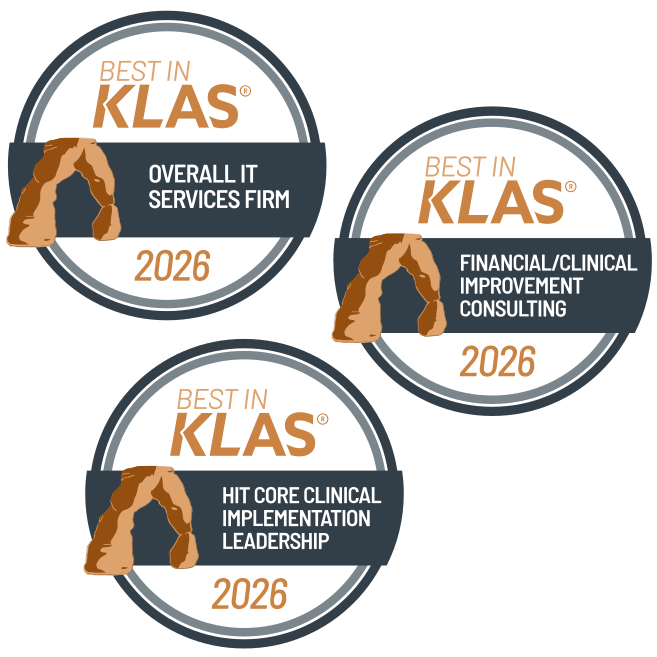
Chartis was named the Best Overall IT Services Firm by KLAS Research and ranked No. 1 in HIT Core Clinical Implementation Leadership and Financial and Clinical Improvement Consulting. Best in KLAS recognizes firms that help healthcare organizations achieve meaningful results and improve care delivery based on client experience and performance.
Chartis provides the best revenue cycle consultants I have ever worked with. They possess a deep knowledge of best practices and industry trends, which they apply in tailored recommendations. Their advice is top notch—not just on what to implement but how to implement it. They are genuinely nice and caring people, whom I recommend without reservation.
”Frequently asked questions
How can healthcare organizations use AI and automation to transform revenue cycle management into a high-value strategic asset?
An EHR delivers greater value when it enables consistent, efficient workflows across the revenue cycle. Optimizing system configuration, automation, reporting, and interoperability can reduce manual work, improve data quality, and accelerate reimbursement.
AI and automation can build on this foundation to transform revenue cycle management from a transactional function into a more proactive, strategic asset. Organizations can apply AI across the revenue cycle to anticipate and prevent denials, automate routine work, prioritize high-value actions, improve decision-making, and accelerate cash. Capturing that value requires aligning AI and automation with core workflows, EHR and technology platforms, data, governance, and operational readiness.
How can healthcare organizations reduce cost to collect while improving performance?
Reducing cost to collect requires a broader strategy than simply reducing expenses and cost. Organizations should evaluate the underlying drivers of cost across operating models, workforce and sourcing, workflows, technology and automation, vendor utilization, and performance management.
This approach helps identify where costs can be structurally removed while protecting or improving revenue capture, cash, productivity, and the patient experience, yielding sustainable margin improvement rather than short term cost reduction.
Why does patient financial experience help transform the revenue cycle?
Patient financial experience is shaped by the same processes that drive revenue cycle performance. Registration, insurance verification, billing, and payment all influence how patients navigate their care and understand their financial responsibility. Improving these workflows helps organizations strengthen both financial performance and the patient experience.

Improving access: University Hospitals scales guided scheduling for better experience, outcomes
The health system set out to give every patient a seamless, consistent, and empowering experience—while streamlining workforce support and ensuring appointment accuracy.
Related insights