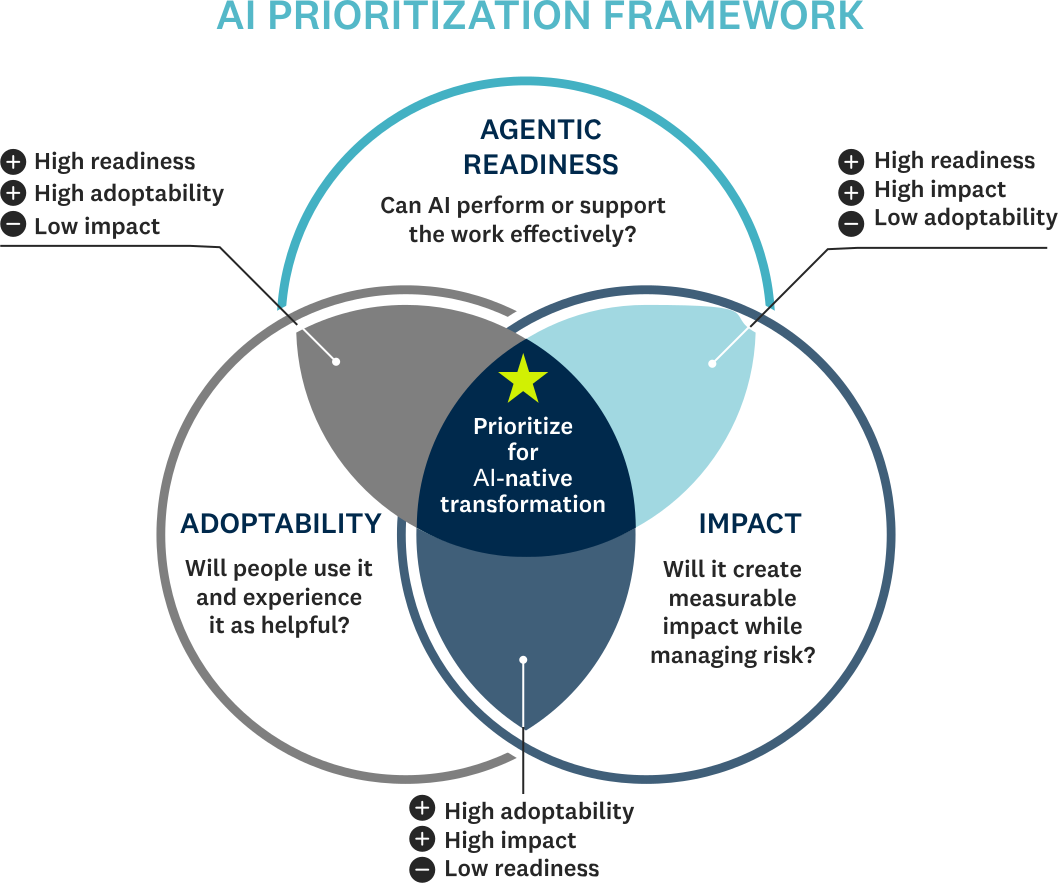
Ambient documentation is a useful example. Adoption has accelerated rapidly, with more than 60% of hospitals now using ambient AI documentation tools. The task is well suited to AI, addresses a clear and pressing need to reduce physician burden, and creates benefits that matter to both clinicians and the enterprise.
While many organizations are still quantifying the full financial impact, early results suggest that ambient documentation can save time, improve physician satisfaction, strengthen documentation quality, and potentially free capacity for additional clinical activity.
1. Agentic readiness: Can AI perform, coordinate, or support the work effectively?
Agentic readiness assesses whether the health system’s administrative process has the technical, data, and knowledge conditions required for agentic AI to perform, coordinate, or support the work effectively.
Metric
Assessment criteria
Standardization
The work follows recognizable patterns, with variation that the health system and its AI tools can categorize and manage.
Verifiability
The health system can validate correctness using rules, reference data, historical outcomes, documentation standards, or system logic.
Data maturity
The necessary data is available, reliable, structured enough for AI use, and accessible through systems or integrations.
Stakeholder simplicity
The work does not depend heavily on trust-building, negotiation, emotional intelligence, or high-touch stakeholder management.
Knowledge clarity
The work is based on explicit rules, decision criteria, and observable patterns, rather than experience or intuition that’s hard to articulate and codify.
2. Adoptability: Will people use it and experience it as helpful?
Adoptability assesses whether an AI-driven solution would solve a real problem, can work in practice, and be trusted by users and stakeholders.
Metric
Assessment criteria
Pain point
The process is time-consuming, manual, duplicative, delayed, frustrating, or error-prone.
User benefit
AI would improve speed, accuracy, consistency, completeness, user experience, or administrative effort.
Operational fit
The health system can embed the solution into current systems, handoffs, and decision points without adding major complexity.
Trustworthiness
The people responsible for the work can confidently explain, review, correct, and use the output.
3. Impact: Will it create measurable impact while limiting risk?
Impact assesses whether the AI opportunity has a strong business case, manageable risk, and a path to scale.
Metric
Assessment criteria
Demand
The process occurs frequently enough or affects enough transactions, cases, or users to justify AI-driven transformation and create meaningful impact.
Value creation: cost
The opportunity can reduce operating costs, improve productivity, shorten cycle time, increase efficiency, or expand workforce capacity.
Value creation: outcomes
The opportunity can improve quality, compliance, revenue capture, patient or employee experience, or other strategic outcomes.
Net value realization
The health system can realize the expected value after accounting for build costs, integration, change management, monitoring, maintenance, governance, and any added burden to other departments.
Measurability
The health system can track benefits through clear operational, financial, quality, compliance, experience, or workforce metrics.
Scalability
The health system can extend or reuse the AI capability across additional teams, sites, functions, populations, workflows, or use cases without disproportionate added cost or complexity.
Error Tolerance
AI mistakes would be low risk, detectable, recoverable, or containable through controls.
Regulatory manageability
The health system can safely use the AI within applicable regulatory, accreditation, contractual, and policy requirements without materially increasing risk or exposure.
Deliver early AI success by focusing on targeted administrative use cases
AI-driven transformation requires more than identifying promising use cases. Health systems need a disciplined way to focus on the administrative opportunities most likely to create measurable value and build momentum toward a broader administrative cost reset.
Rather than pursuing every possible AI application, organizations should sequence the administrative opportunities where the work is suitable for AI-driven transformation, users are likely to adopt the solution, and the impact justifies the investment.
Additional contributors: Cindy Lee, Chief Strategy Officer, and Anneliese Gerland, Partner and Senior Vice President, Strategy
How AI can reset healthcare’s administrative cost structure
Agentic AI creates an opportunity to manage cost and service performance together, rather than as competing priorities. We examine what this would look like in the supply chain and revenue cycle.
Read more