Healthcare is undergoing a technology-driven transformation. It holds the promise of a new ecosystem of care that will enable better outcomes, more personalization, and long-term financial sustainability.
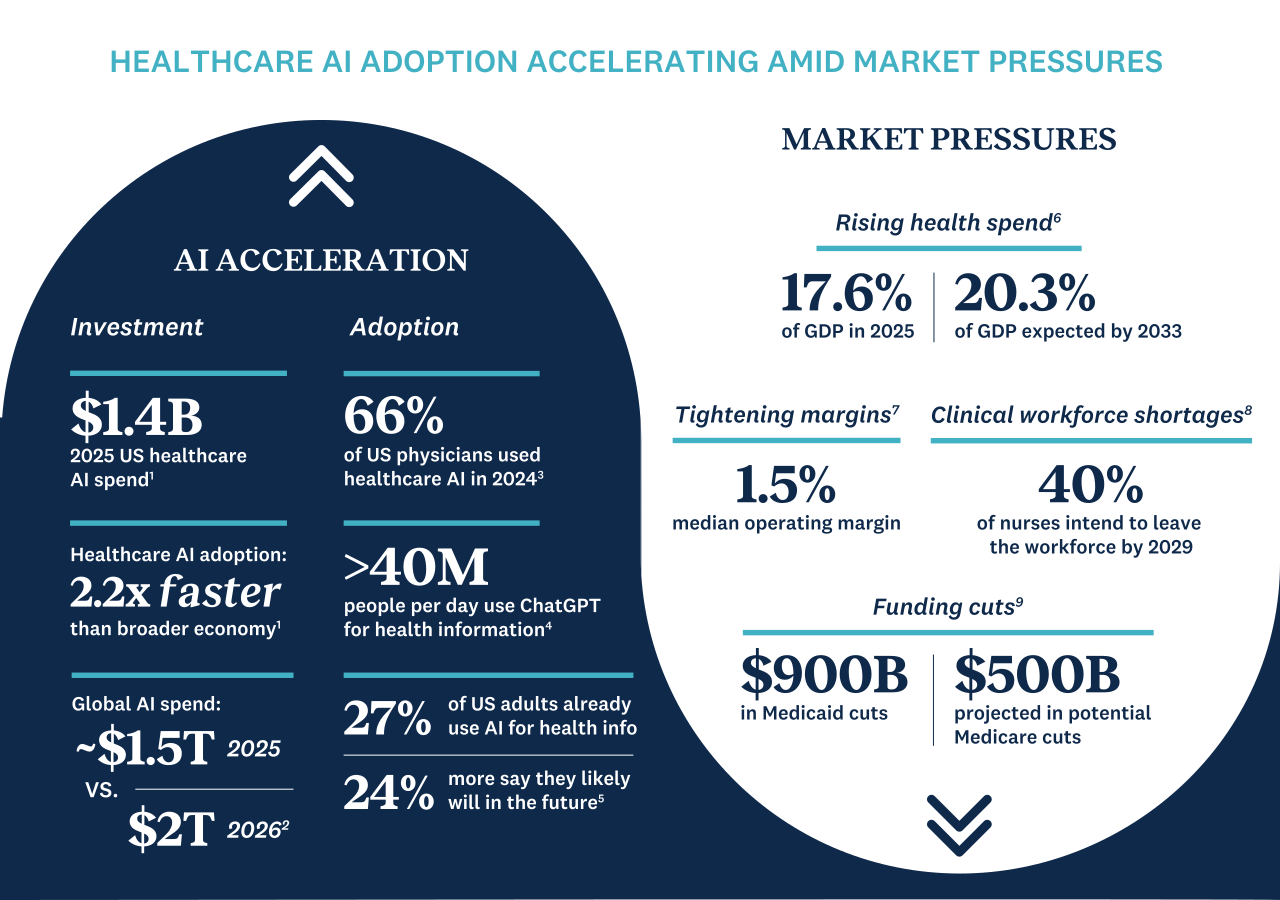
Yet the industry’s chronic ailments of access and affordability are likely to get worse before they get better as healthcare organizations are forced to make hard choices to offset expected revenue losses in the near term while also making strategic capital investments.
In the work ahead, we believe health systems should orient around the following domains:
- Harness technology to orchestrate care across a multimodal network
- Move consumerism beyond a buzzword toward technology-powered personalization
- Build trust and forge alliances to create solutions
Start technology-driven transformation with human-centered principles
While health systems face considerable pressures ahead, healthcare leaders’ belief that advanced technology can enable better, more sustainable care delivery could pay off. But that will require organizations to ground this new stage of technical evolution in human-centric principles that prioritize trust, collaboration, and accountability. Only with this unique orientation can healthcare deliver the sustainable impact both healthcare consumers and organizations need.
Sources
1. “2025: The State of AI in Healthcare,” Menlo Ventures, Oct. 21, 2025, https://menlovc.com/perspective/2025-the-state-of-ai-in-healthcare/.
2. “Gartner Says Worldwide AI Spending Will Total $1.5 Trillion in 2025,” Gartner, Sept. 17, 2025, https://www.gartner.com/en/newsroom/press-releases/2025-09-17-gartner-says-worldwide-ai-spending-will-total-1-point-5-trillion-in-2025.
3. Tanya Albert Henry, “2 in 3 physicians are using health AI—up 78% from 2023,” Feb. 26, 2025, American Medical Association, https://www.ama-assn.org/practice-management/digital-health/2-3-physicians-are-using-health-ai-78-2023.
4. “AI as a Healthcare Ally: How Americans are navigating the system with ChatGPT,” OpenAI, January 2026, https://cdn.openai.com/pdf/2cb29276-68cd-4ec6-a5f4-c01c5e7a36e9/OpenAI-AI-as-a-Healthcare-Ally-Jan-2026.pdf.
5. Amelia Burke-Garcia, “AI Is Changing How Americans Access Health Information—But Many Remain Skeptical,” NORC at the University of Chicago, Nov. 2025, https://www.norc.org/research/library/ai-changing-how-americans-access-health-information-many-remain-skeptical.html.
6. Sean P. Keehan, et al, “National Health Expenditure Projections, 2024–33: Despite Insurance Coverage Declines, Health To Grow As Share Of GDP,” Health Affairs, July 2025, https://www.healthaffairs.org/doi/pdf/10.1377/hlthaff.2025.00545.
2025 was the third straight year of ≥6% increases. Family premiums have increased ~25% over 5 years. “2025 Employer Health Benefits Survey,” KFF, Oct. 22, 2025, https://www.kff.org/health-costs/2025-employer-health-benefits-survey/.
7. For publicly traded insurers, aggregate EBITDA was down 8.6% in 2024 and 6.6% in H12025. For health systems, the median operating margin was 1.5% in FY2024, versus 0.5% the previous year. “Medians–Profitability improves as revenue grows faster than expenses,” Moody’s Ratings, August 23, 2025, https://www.moodys.com/research/doc--PBC_1455260.
8. Almost 40% of nurses intend to leave the workforce by 2029. “NCSBN Research Highlights Small Steps Toward Nursing Workforce Recovery; Burnout and Staffing Challenges Persist,” NCSBN, April 17, 2025, https://www.ncsbn.org/news/ncsbn-research-highlights-small-steps-toward-nursing-workforce-recovery-burnout-and-staffing-challenges-persist.
31 out of 35 physician specialties face ongoing shortages. “Addressing Health Care Workforce Shortages,” NIHCM Foundation, July 16, 2025, https://nihcm.org/publications/addressing-health-care-workforce-shortages.
9. Rhiannon Euhus et al, “Allocating CBO’s Estimates of Federal Medicaid Spending Reductions Across the States: Enacted Reconciliation Package,” KFF, July 23, 2025, https://www.kff.org/medicaid/allocating-cbos-estimates-of-federal-medicaid-spending-reductions-across-the-states-enacted-reconciliation-package/.
Zachary Levinson, Tricia Neuman, and Jamie Godwin, “What Are the Implications of the 2025 Budget Reconciliation Bill for Hospitals?,” KFF, June 12, 2025, https://www.kff.org/medicaid/what-are-the-implications-of-the-2025-budget-reconciliation-bill-for-hospitals/.
Aatish Bhatia et al, “The US is Funding Fewer Grants Across Every Area of Science and Medicine,” New York Times, Dec. 2, 2025, https://www.nytimes.com/interactive/2025/12/02/upshot/trump-science-funding-cuts.html.